Gurukul
Education Rooted in Place
The project brief demanded the design of a school (from kindergarten to class VIII) in Hodka, a culturally rich village in Kutch, Gujarat. The village possesses a unique “genius loci,” characterized by its challenging desert climate and the traditional cultural beliefs of its society, which resists modern education due to the fear of diluting core values. This resistance is reflected in the remarkably low literacy rate of 33%, despite the presence of three schools in the village. Consequently, the project necessitated a comprehensive examination of both the climatology and the ethnography of the rural fabric. This study led to the examination of the vernacular architecture of the region, Bhongas, which is the culmination of the response of generations of the locals to the “genius loci”.
Hodka, a small village in the Banni region of Kutch district, Gujarat, embodies a deep interconnection between its socio-cultural traditions and its harsh climatic setting, but also a growing disconnection between local lifeways and formal schooling. Situated on a flat, sandy plain with sparse vegetation and minimal rainfall (around 276 mm annually), the village experiences extreme diurnal temperature variations and strong southwest winds, conditions that shape both settlement patterns and traditional building forms. The residents, primarily from the Halepotra Muslim and Meghwal Hindu communities—maintain centuries-old crafts such as intricate embroidery, lippan kaam (mud mural work), and the construction of circular bhungas, practices that root knowledge in craft, oral tradition, and the rhythms of pastoral-desert life rather than in classroom-based instruction.
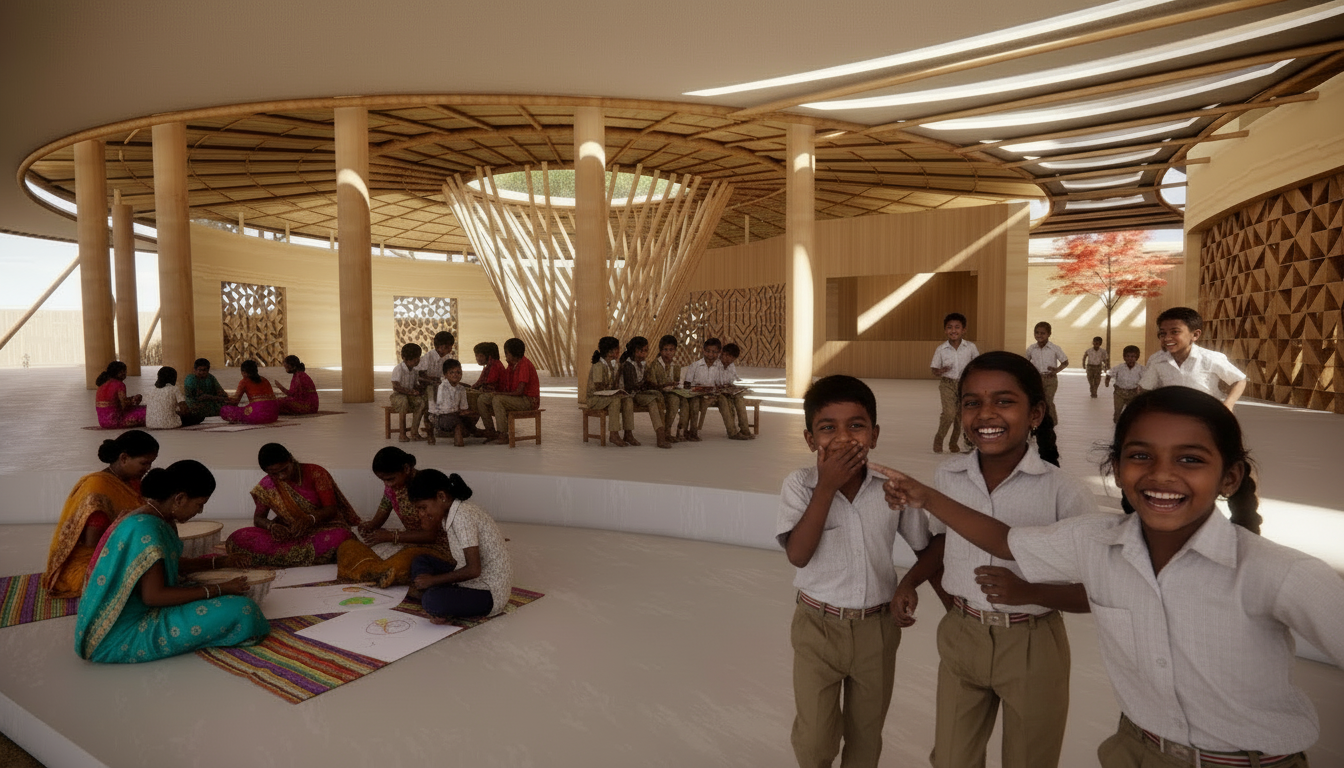
Although Hodka has multiple schools with adequate infrastructure, literacy remains low, suggesting that the form and content of modern education, and the concrete institutional architectures that house it, sit at odds with the community’s values, languages, and inherited knowledge systems, making these schools symbolically distant and contributing to poor enrollment, retention, and learning outcomes. In everyday life, cultural identity continues to be affirmed more powerfully through the colourful textiles, communal spaces, and climate-responsive bhungas than through the school campus, even as tourism and events like the Rann Utsav introduce new economic opportunities that depend on the very traditions that formal education has not fully learned to recognise or integrate.
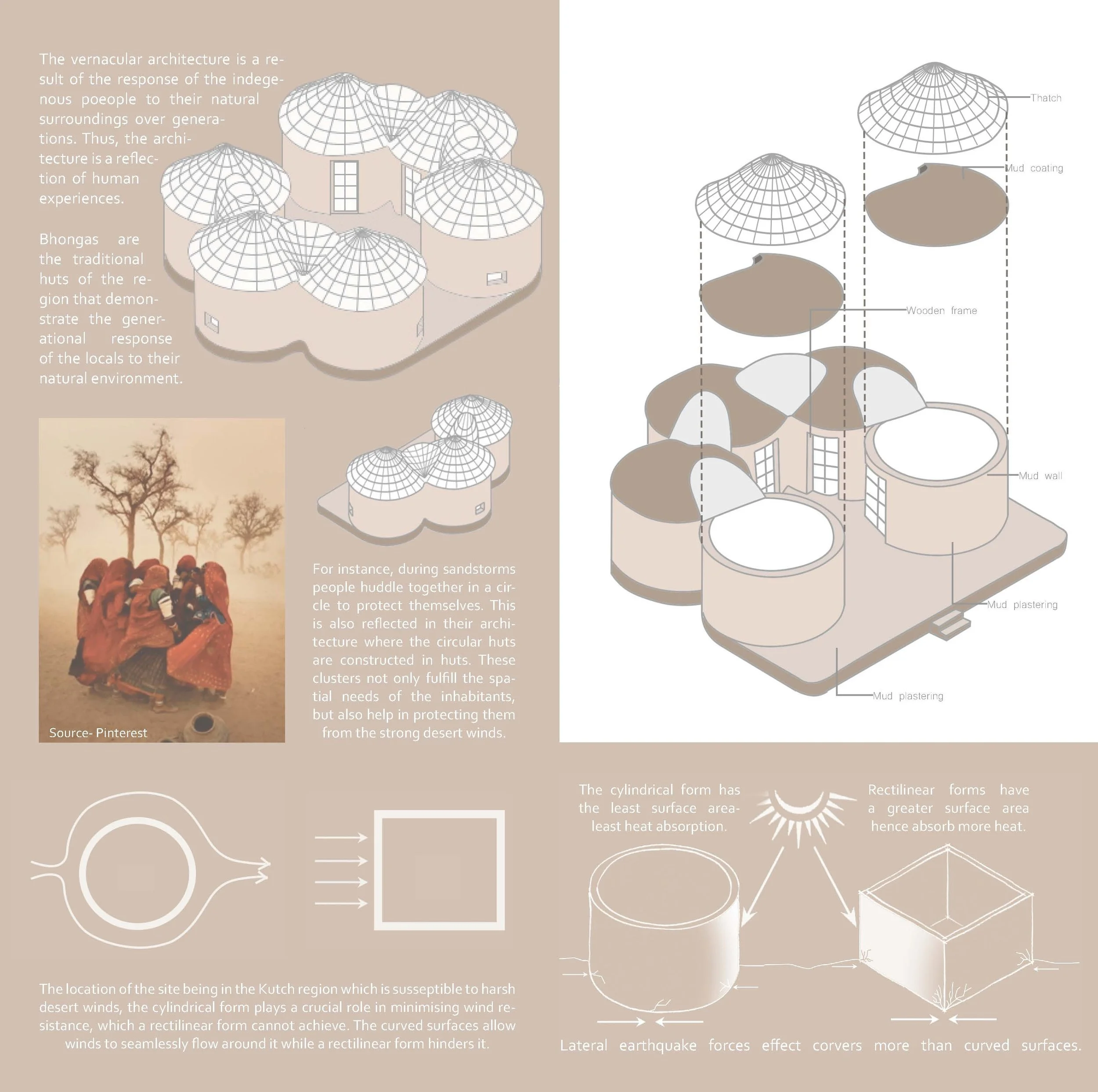
The bhonga is a centuries-old vernacular dwelling type of the Kutch region, whose deceptively simple cylindrical form is a precise response to the desert landscape's seismic, climatic, and material conditions. In plan, the circular wall acts as a shell, distributing lateral inertial forces uniformly around its perimeter rather than concentrating them at corners, giving it extraordinary resistance to the kind of earthquake forces that devastated Bhuj in 2001, the bhongas of Hodka were among the least damaged structures.
The conical thatch roof is equally strategic: constructed from lightweight local timber, bamboo, and grass sourced from the Banni grassland, it develops minimal inertial mass during seismic events and, even in collapse, poses little danger to occupants. Thermally, the thick mud walls, plastered with gobar lipan, a cow dung and earth compound, act as high-mass insulators, absorbing heat during the day and releasing it slowly at night, moderating the extreme diurnal temperature swings of the desert. The curved surface also minimises direct perpendicular exposure to solar radiation, reducing heat gain compared to flat-walled construction.
Small, strategically placed windows and an airtight threshold restrict the entry of the hot desert wind loo by day and prevent excessive cooling by night, while simultaneously keeping out sandstorms, making the bhonga a climatically calibrated instrument as much as a dwelling.
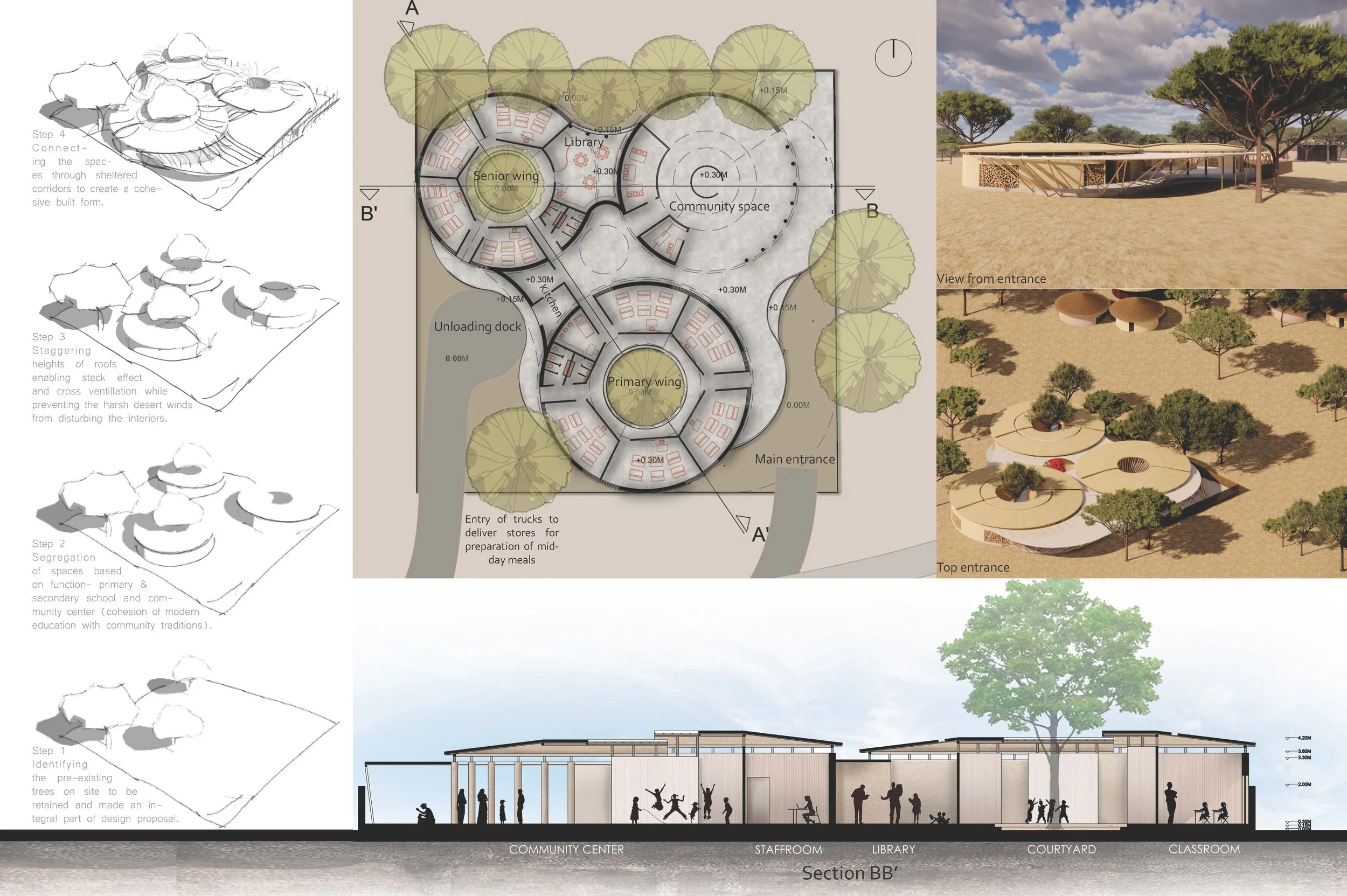
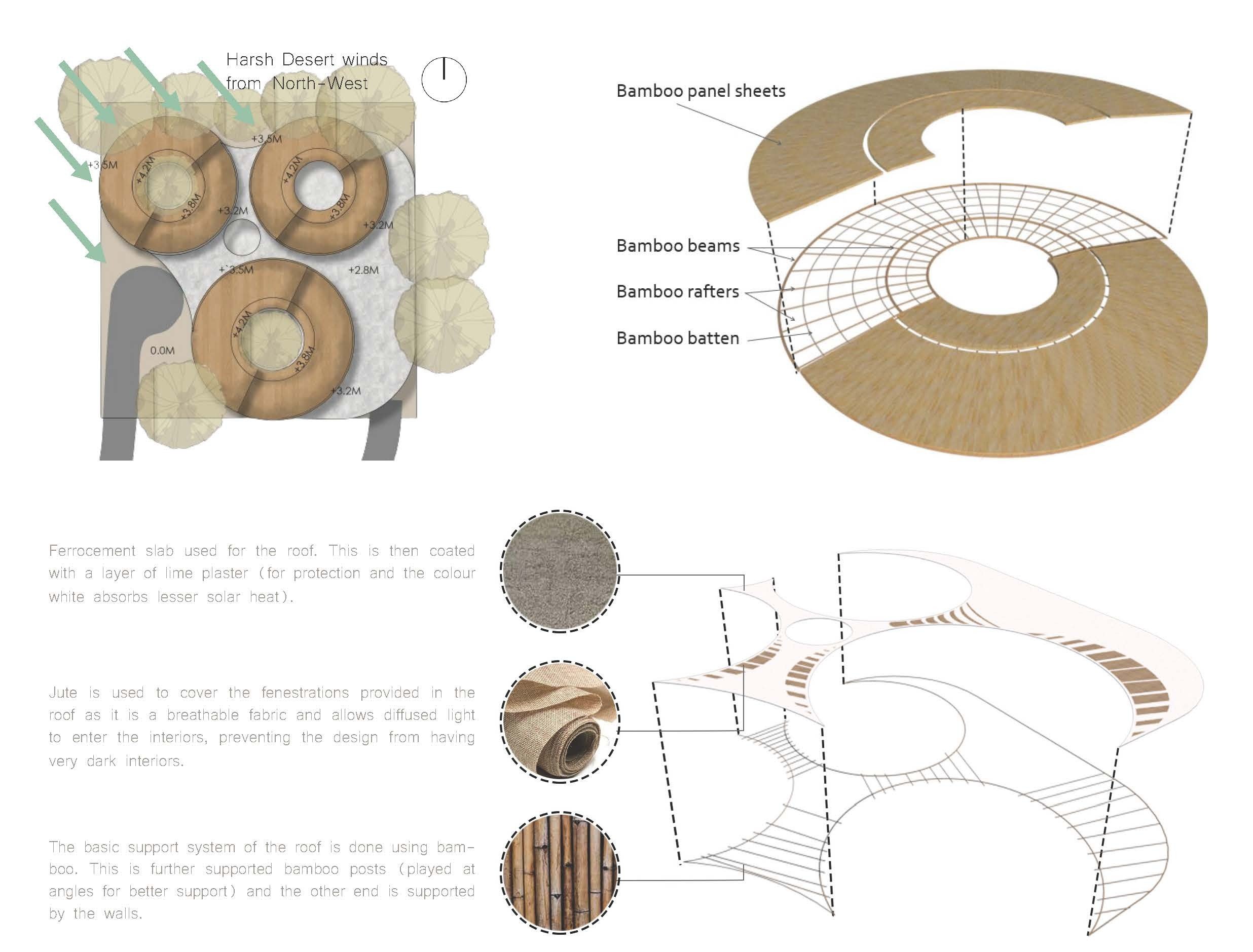
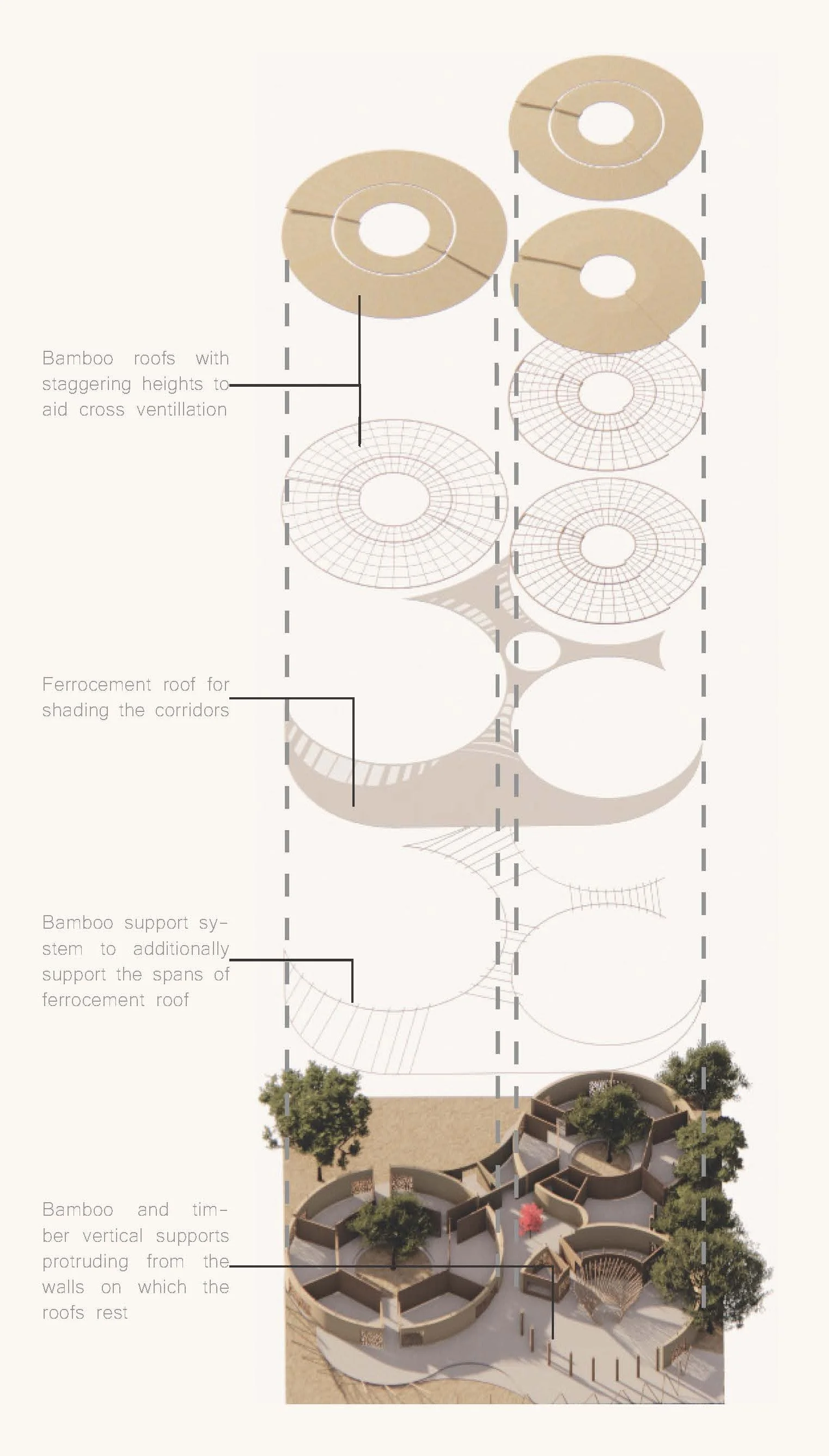
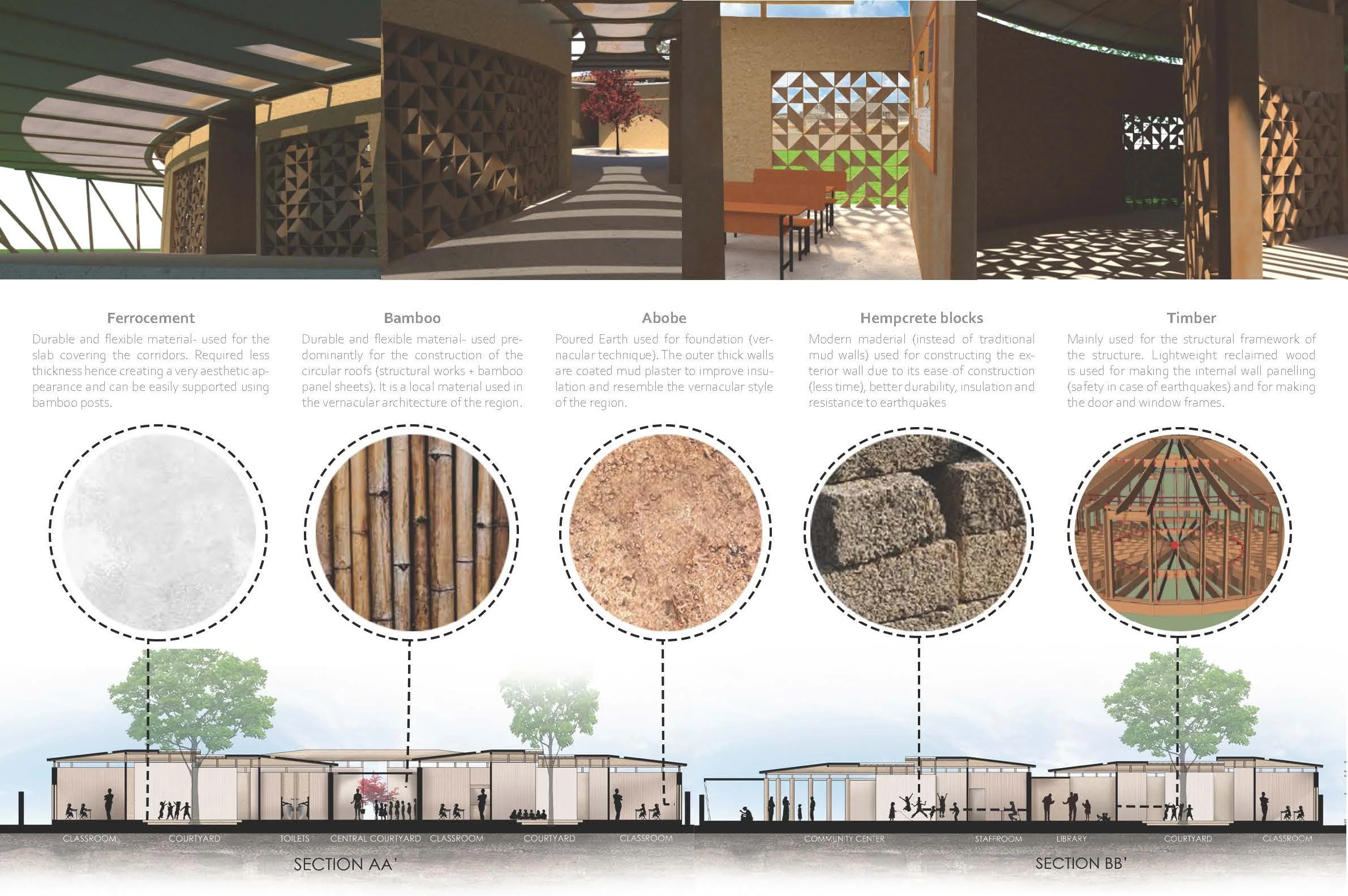
The roof is conceived as a layered, breathable canopy that moderates desert winds while driving natural ventilation through the interiors. Staggered circular bamboo roofs and the intermediate ferrocement shading layer create continuous shaded air channels, so the harsh north‑west winds are largely skimmed over the building while cooler, slower air is drawn into the rooms below. The offset roof heights and central openings accentuate the stack effect, allowing warm air to rise and escape, which in turn pulls fresh air laterally through the cross‑ventilated corridors and courtyards. Together, this stepped, porous roofscape reduces heat gain, protects from dust, and maintains comfortable airflow without mechanical systems.