
Earth Vaults Material Analysis
A Material, Thermal & ESG Synthesis for Earth Construction
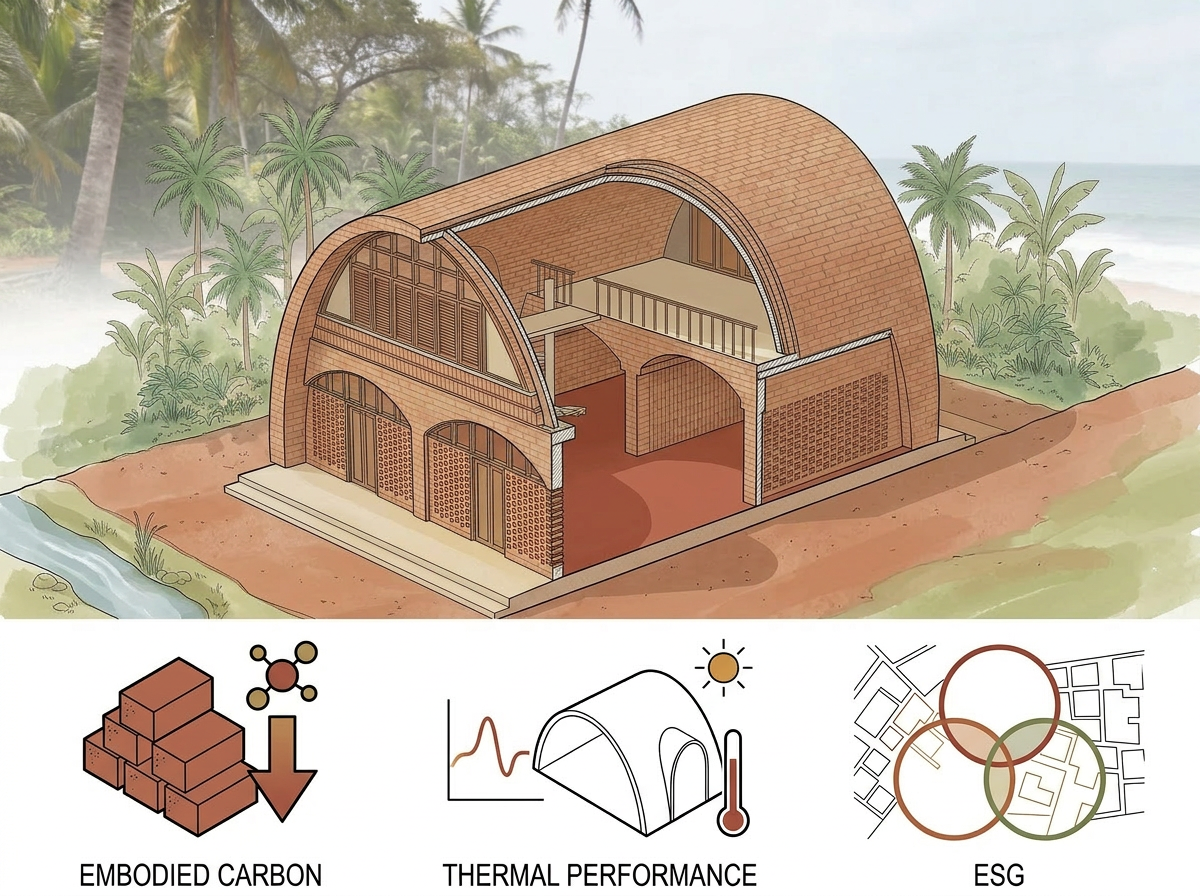
This analysis evaluates the environmental and social performance of Yakshahalli, a proposed artisan settlement in Tenka, coastal Karnataka, across three intersecting frameworks: embodied carbon and lifecycle assessment of the primary construction material, Compressed Stabilized Earth Blocks — thermal performance benchmarking of the CSEB vault roofing system against conventional timber alternatives, and an ESG reporting framework that captures the project's environmental, social, and governance dimensions. Together, these assessments constitute a post-design audit that grounds the project's sustainability claims in measurable, comparative, and replicable terms.
Material & Embodied Carbon Analysis
The Material: CSEB
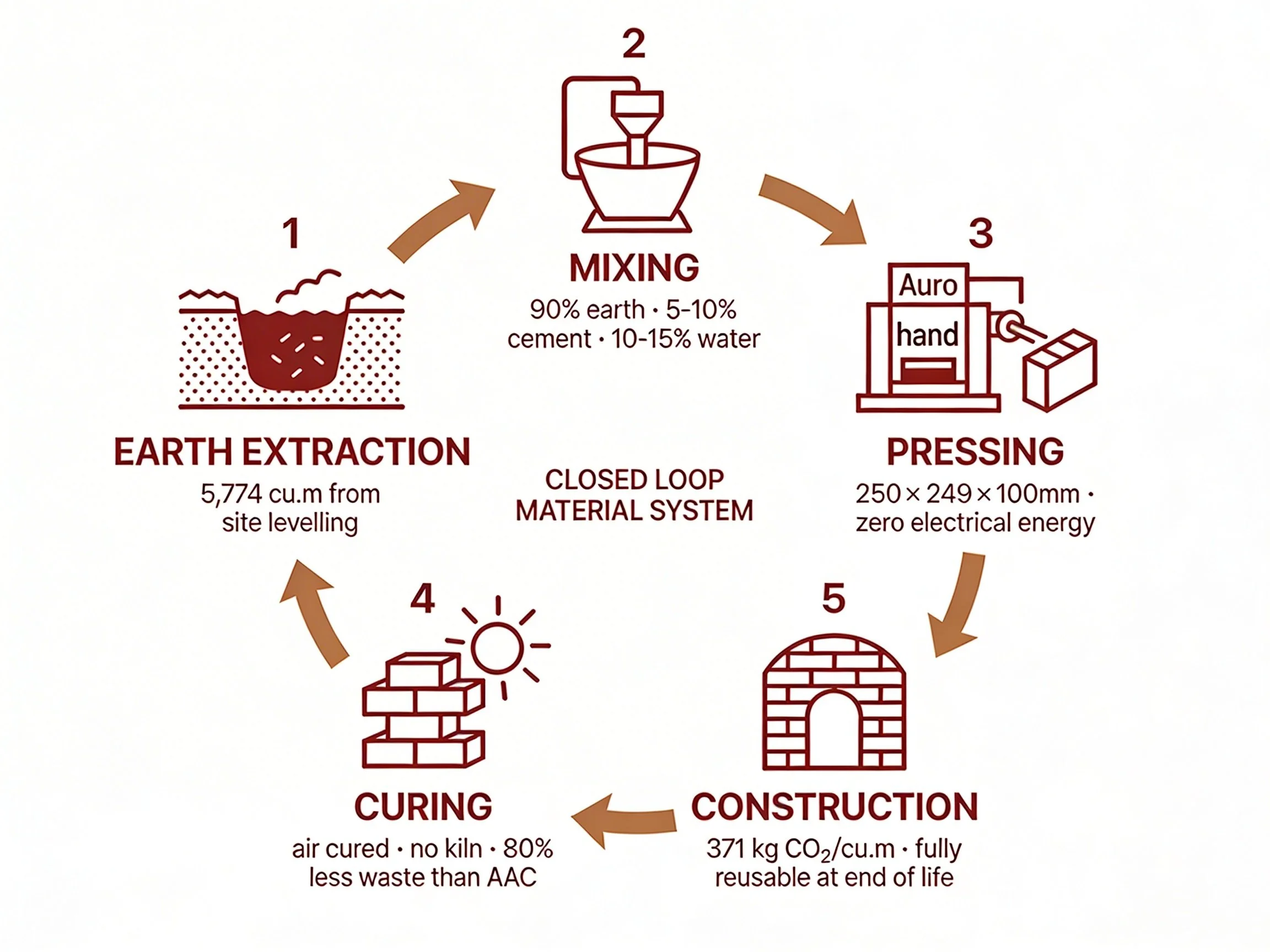
Compressed Stabilized Earth Blocks are produced on site using a mixture of approximately 90% lateritic earth and 10% cement stabilizer, with water sourced from the stream along the eastern site boundary. The blocks are formed using manually operated Auro-handpress machines, requiring no kiln firing and generating minimal process waste. The entire production cycle — from raw material extraction to block formation — takes place within the site boundary, eliminating transportation as a significant carbon contributor and creating a closed-loop material system that is both economically and ecologically viable for the rural context.
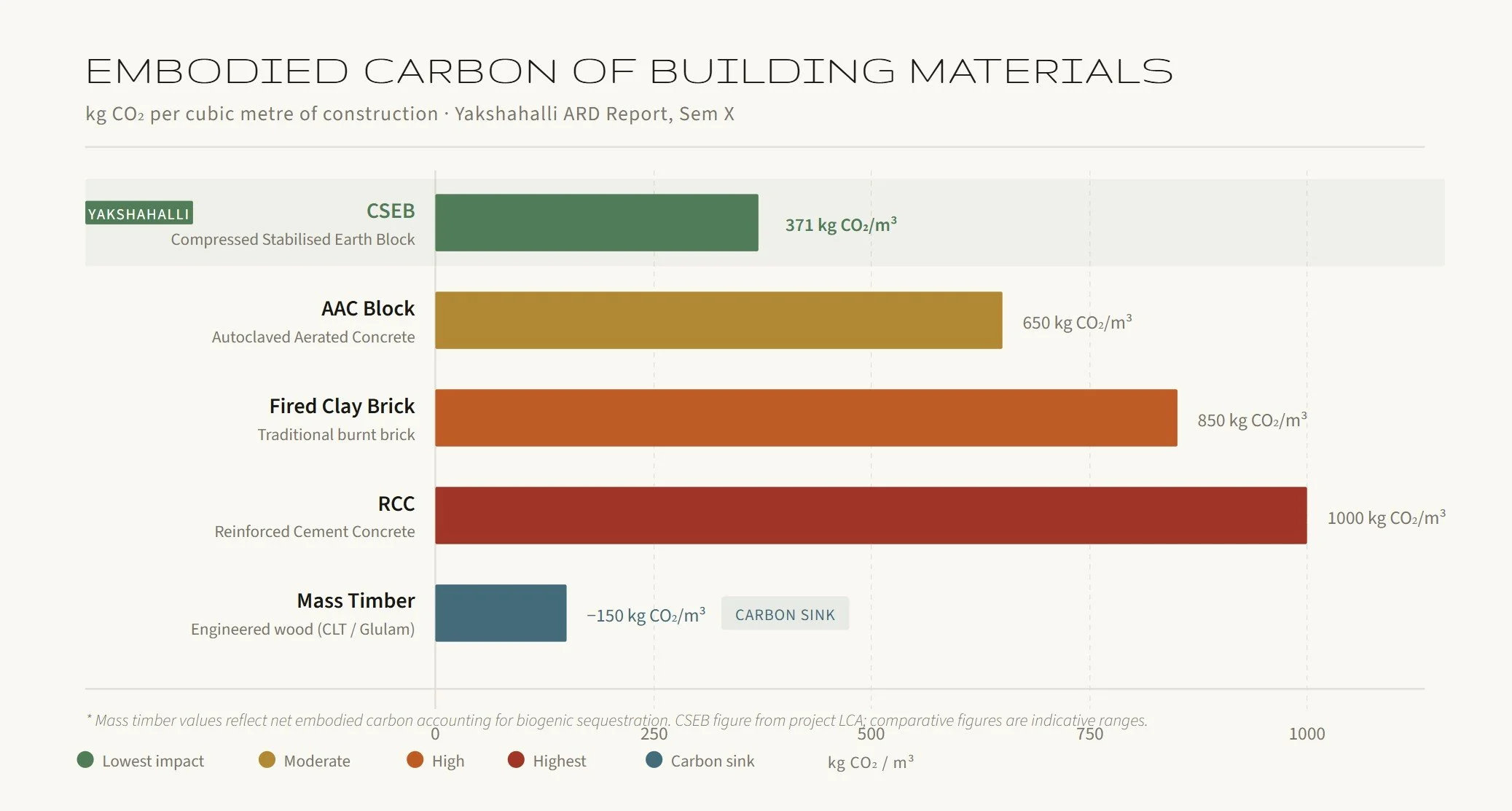
Embodied Carbon: CSEB vs Alternatives
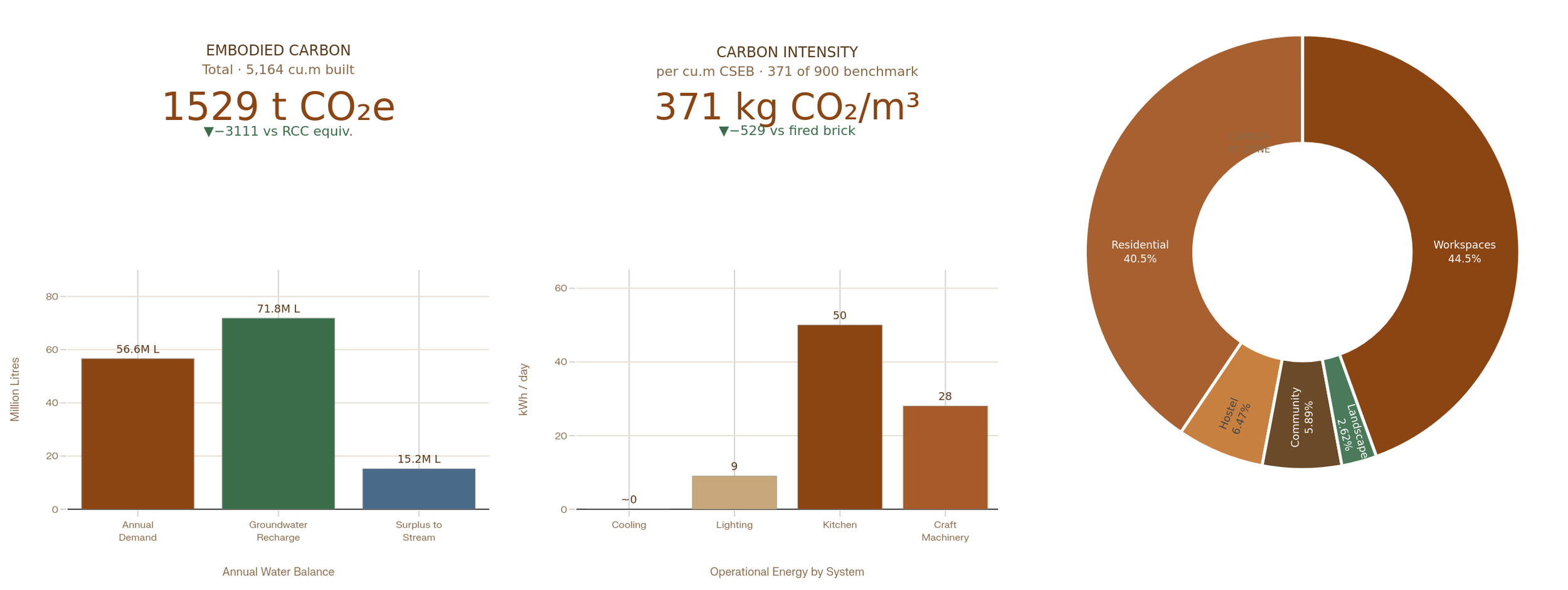
The embodied carbon of CSEB at Yakshahalli is calculated at 371 kg CO₂ per cubic metre of construction, derived from the cement content, minimal transportation of stabilizers, and on-site electricity use for production. This figure represents a substantial reduction when compared with fired clay brick (approximately 800–900 kg CO₂/cu.m), reinforced concrete (approximately 900–1,100 kg CO₂/cu.m), and AAC blocks (approximately 600–700 kg CO₂/cu.m). Notably, the use of Auro-handpress machines, which eliminate electrical energy input during pressing, reduces the production-phase carbon further, reinforcing the choice of CSEB as the structurally, economically, and environmentally optimal material for this project.
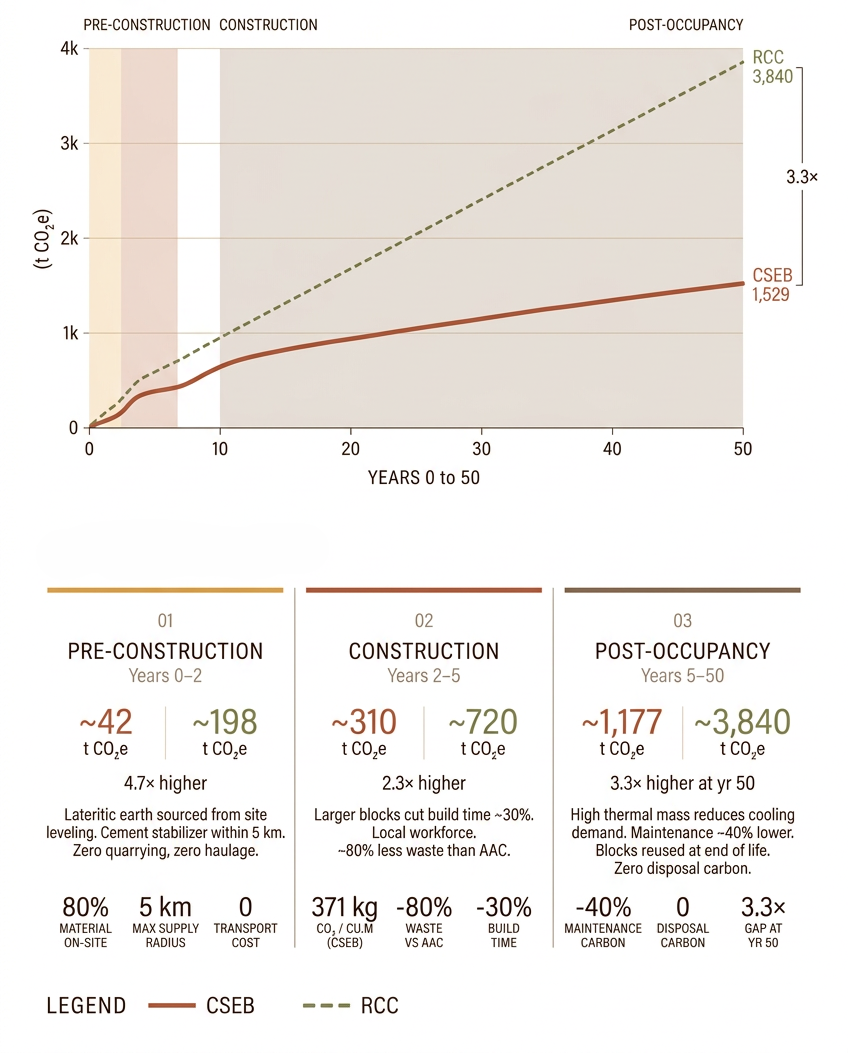
Lifecycle Carbon Across Three Phases
The lifecycle carbon assessment is structured across pre-construction, construction, and post-occupancy phases. In the pre-construction phase, the sourcing of over 80% of raw material from site levelling (yielding approximately 5,774 cu.m of earth against a requirement of 4,131 cu.m) eliminates quarrying, long-distance haulage, and associated emissions. The construction phase benefits from CSEB's larger block dimensions relative to fired brick, reducing the number of units required per square metre of wall and shortening build time by approximately 30%, with a corresponding reduction in site energy and labour carbon. Post-occupancy, CSEB's higher thermal mass significantly reduces the energy demand for cooling in the tropical coastal climate of Tenka, while its lower maintenance requirements and complete reusability at end of life, the blocks can be re-crushed and reused as fresh CSEB without chemical treatment, close the material loop and eliminate disposal carbon entirely.
Thermal Performance: CSEB Vaults vs Timber Roofs
Thermal Performance: CSEB Vaults vs Timber Roofs
The choice of CSEB barrel, segmental, and groin vaults as the primary roofing system at Yakshahalli was determined by three converging conditions: the scarcity of structural timber in coastal Karnataka, annual rainfall of approximately 3 metres, and the need for climate-responsive construction without mechanical cooling. The vaulted geometry performs a dual thermal role simultaneously. Its convex external surface reduces the plan area directly exposed to peak afternoon solar radiation, the curved profile distributes incidence across a larger angular range, lowering instantaneous heat flux at any given point compared to a flat or pitched plane. Concurrently, the 300mm compressed earth mass acts as a thermal flywheel: it absorbs daytime heat and re-radiates it only after sunset, when external temperatures have already dropped.
This produces a measured time lag of 8–10 hours between peak external temperature and peak interior surface temperature, consistent with published values for compressed earth blocks at equivalent thickness, which record lags of 10.5 hours at 250mm. A conventional lightweight timber rafter-and-tile roof achieves a lag of only 1-2 hours, causing interior temperatures to track and often exceed external peaks closely. In the humid tropical climate of coastal Karnataka, where temperatures range from 22°C to 38°C and humidity regularly exceeds 80%, this differential is between passive comfort and mechanical dependence. Empirical studies of CSEB construction in comparable tropical conditions confirm indoor temperature ranges of 24-34°C against outdoor swings of 23-37°C, a direct reduction in amplitude of approximately 9°C. Across thermal mass, time lag, peak interior temperature, U-value, and maintenance load, the CSEB vault outperforms lightweight timber on every climate-critical parameter, conceding only on embodied carbon due to the cement stabiliser content.
Ventilation Performance
The gable windows positioned at the vault apex, combined with brick jali openings in the lower walls, create a continuous vertical pressure gradient within the workspace volumes. Warm air stratifies toward the crown of the vault and exits through the gable, while cooler air enters at lower levels through the jalis and operable timber panels. This passive stack effect supplements the convective cooling provided by the vault geometry and eliminates the need for mechanical ventilation in all but the most extreme heat events. Daylighting studies confirm that the gable openings introduce diffused northern and southern light throughout the day without direct solar gain, keeping interiors luminous and thermally stable simultaneously.
ESG Reporting Framework
Standard ESG reporting frameworks are designed primarily for corporate real estate or large institutional buildings. Applying them to a rural community settlement requires reorienting the metrics toward local ecological systems, informal economies, and cultural continuity. The ESG framework developed for Yakshahalli adapts standard environmental, social, and governance categories to reflect the specific conditions and aspirations of the project, offering a transferable model for post-design assessment of rural community architecture in the Global South.
E — Environmental
The environmental performance of Yakshahalli is assessed across four categories: embodied carbon, operational energy, water management, and ecological footprint. Total embodied carbon for the built programme is calculated at approximately 1,529 tonnes CO₂ equivalent across 5,164 cu.m of built volume — substantially below the equivalent figure for a conventional RCC construction of the same programme. Operational energy demand is near-zero for cooling and ventilation given the passive systems described above, with residual demand limited to lighting, kitchen equipment, and craft machinery. The water management strategy achieves a positive annual balance, recharging approximately 71.8 million litres to the groundwater table against a total annual demand of 56.6 million litres, generating a surplus of 15.2 million litres that drains naturally to the adjacent stream. The site's ecological footprint is net-positive, with bio-drainage planting, productive homestead gardens, and natural landscape retention together increasing biodiversity and green cover relative to the pre-design baseline.
S — Social
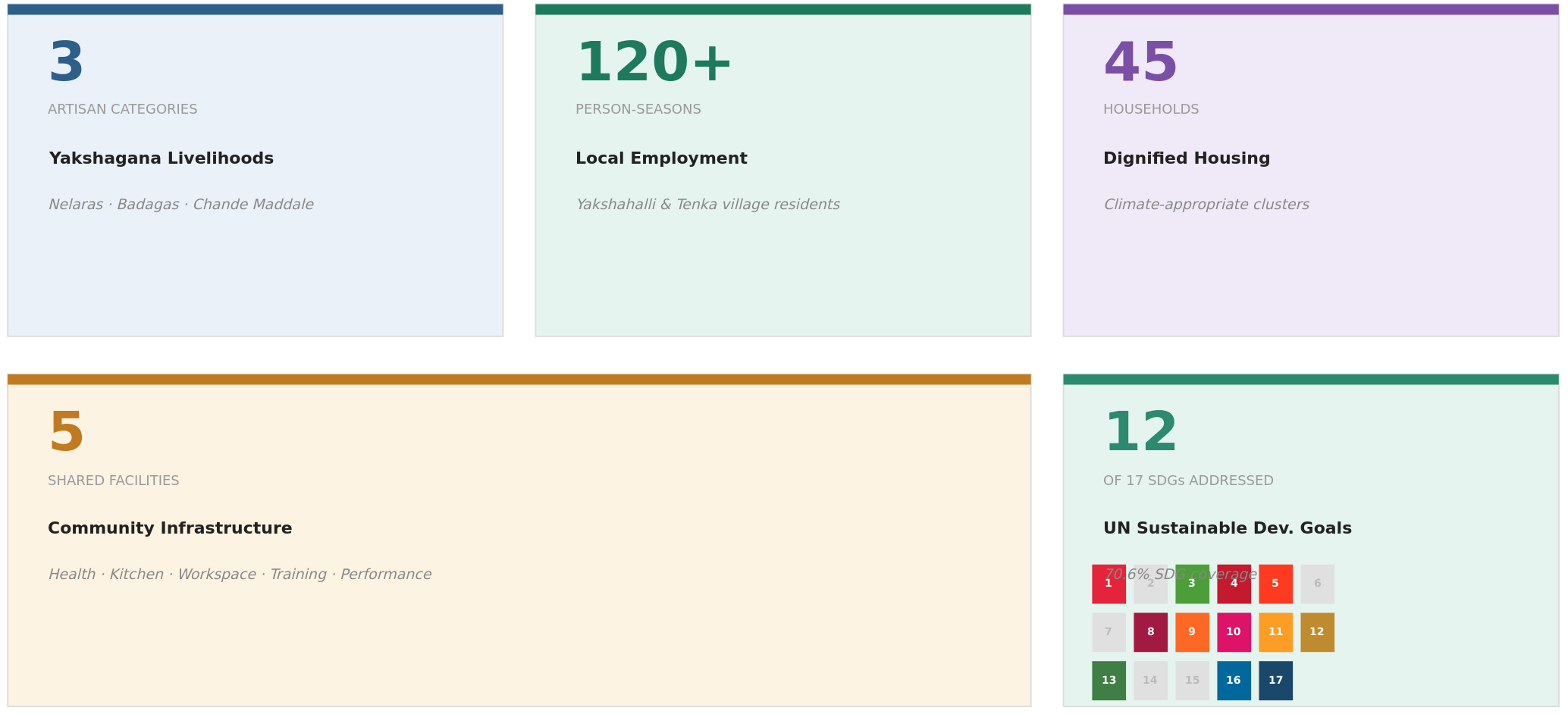
The social performance of Yakshahalli is evaluated across livelihood, equity, health, and cultural dimensions. The programme directly supports the livelihoods of three categories of Yakshagana-associated artisans, the nelaras (stage builders), badagas (costume makers), and chande maddale (drum makers), by providing dedicated workspace, storage, training facilities, and cooperative sales infrastructure within a single settlement. Housing provision addresses the specific challenges of a scattered artisan community, offering dignified, climate-appropriate residential clusters with equitable access to shared facilities including a primary health unit, community kitchen, and cultural performance space. The programme is designed to be gender-inclusive across all workspace and training typologies, and the phased implementation model ensures that local labour is prioritised throughout the construction process, generating employment for residents of both Yakshahalli and the broader Tenka village.
G — Governance
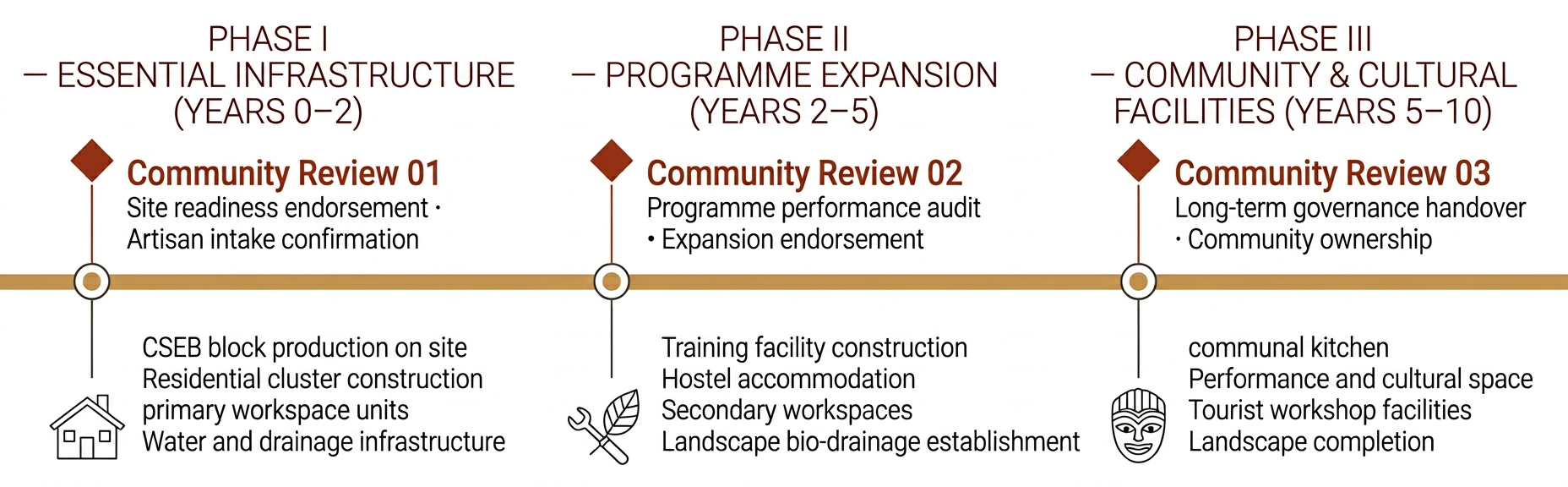
The governance dimension of the framework addresses material traceability, construction transparency, community participation, and phased delivery accountability. The on-site production of CSEB creates a fully traceable material supply chain, with raw material sourcing, block production, and structural deployment all occurring within a defined and documentable boundary. The phased implementation strategy embeds community oversight at each stage of delivery, ensuring that design decisions can be reviewed, adapted, and endorsed by the artisan community as the settlement evolves. The project's alignment with twelve UN Sustainable Development Goals provides an internationally legible accountability framework, while the use of locally available and replicable construction techniques ensures that the governance model can be maintained by the community independently of external technical expertise over time.
Synthesis
The three frameworks, embodied carbon, thermal performance, and ESG, converge on a consistent finding: the design decisions made at Yakshahalli, particularly the choice of CSEB, the vault roofing system, and the landscape-integrated water strategy, are not only architecturally coherent but demonstrably superior in performance terms to conventional alternatives across environmental, social, and governance dimensions. The analysis demonstrates that sustainability in rural architecture is not contingent on technological complexity or high capital investment, but on the depth of engagement with local material systems, ecological conditions, and community structures. Yakshahalli proposes, through its built fabric and post-design evidence base, that the most durable form of sustainable architecture is one that communities can build, maintain, adapt, and own entirely on their own terms.