
Post-Design Embodied Carbon Analysis
Sustainability and Carbon Reduction Framework for Alley_Eblana Brewery Retrofit
This post-design analysis evaluates the embodied carbon implications of structural interventions proposed for the Alley-Eblana Brewery retrofit in Mission Hill, Boston. Working within a 50–100 year building lifespan, the analysis quantifies material volumes, compares structural system options against RIBA 2030 Challenge targets, and identifies material-based strategies to minimize lifecycle carbon, from slab and core selection to local net-zero cement supply chains.
Where Carbon Lives
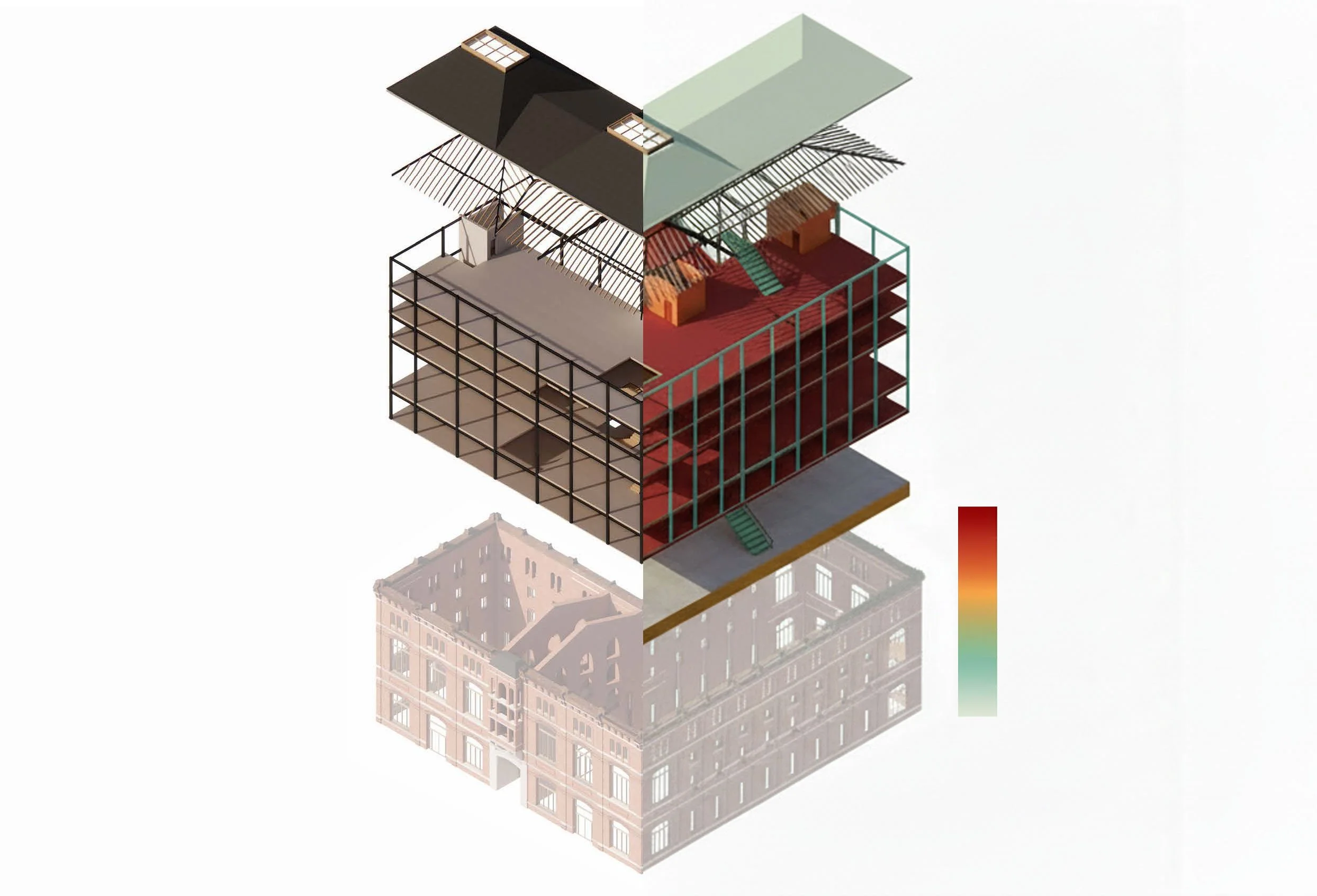
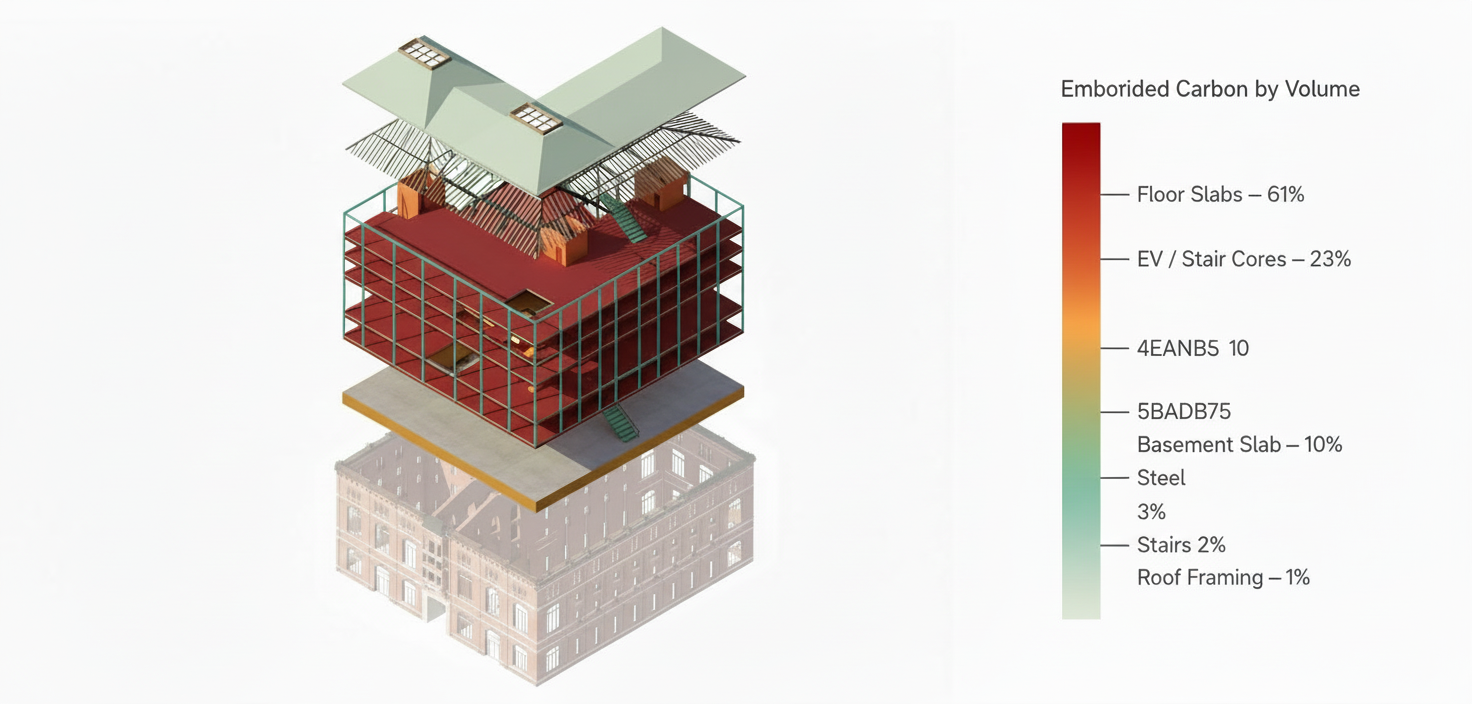
The first step in any post-design carbon assessment is understanding which building elements drive material demand. For the Alley-Eblana retrofit, new interventions include a basement slab, steel columns and beams, floor slabs, stair and elevator cores, and a hybrid roof structure. When broken down by volume, floor slabs and cores together account for 84% of all new material — making them the primary lever for embodied carbon reduction. Steel, roof framing, and stairs together comprise the remaining 16%, each individually modest but collectively significant when multiplied across a multi-storey structure.
Material Options: CLT vs. Low-Carbon Concrete
With floor slabs and cores identified as the critical material decision, the analysis compared two structural system options: cross-laminated timber (CLT) and optimized reinforced concrete. Using the Feilden Clegg Bradley Studios Interactive Carbon Calculator, lifecycle embodied carbon was assessed for both across a 100-year building life.
Option 1 - CLT Slabs and Cores: Total lifecycle embodied carbon of 176 kgCO₂e/m², falling to 104 kgCO₂e/m² when sequestered biogenic carbon is included. This comfortably meets the RIBA 2025 target (~650 kgCO₂e/m²) and sits well below the 2030 target of 500 kgCO₂e/m².
Option 2 - Concrete Slabs and Cores (RC 32/40, 70% GGBS): Total lifecycle embodied carbon of 209 kgCO₂e/m², or 185 kgCO₂e/m² including sequestration. This also meets both RIBA targets and closely tracks the CLT option on a like-for-like basis.
While CLT performs well on paper, especially when sequestered carbon is counted, its headline figures obscure significant hidden costs: unsustainable forestry practices that release stored carbon prematurely, energy-intensive manufacturing, up to 80% of offcuts going to short-lived non-sequestering products, and dependency on synthetic adhesives that complicate end-of-life recycling. For a building designed to last 100 years, these uncertainties shift the preferred option toward optimized low-carbon concrete.
GGBS and Net-Zero Cement
The preferred concrete specification, RC 32/40 with 70% GGBS, replaces 70% of Portland cement with ground granulated blast-furnace slag, a byproduct of the steel industry. This dramatically reduces process emissions by displacing the most carbon-intensive component of conventional concrete without compromising structural performance.
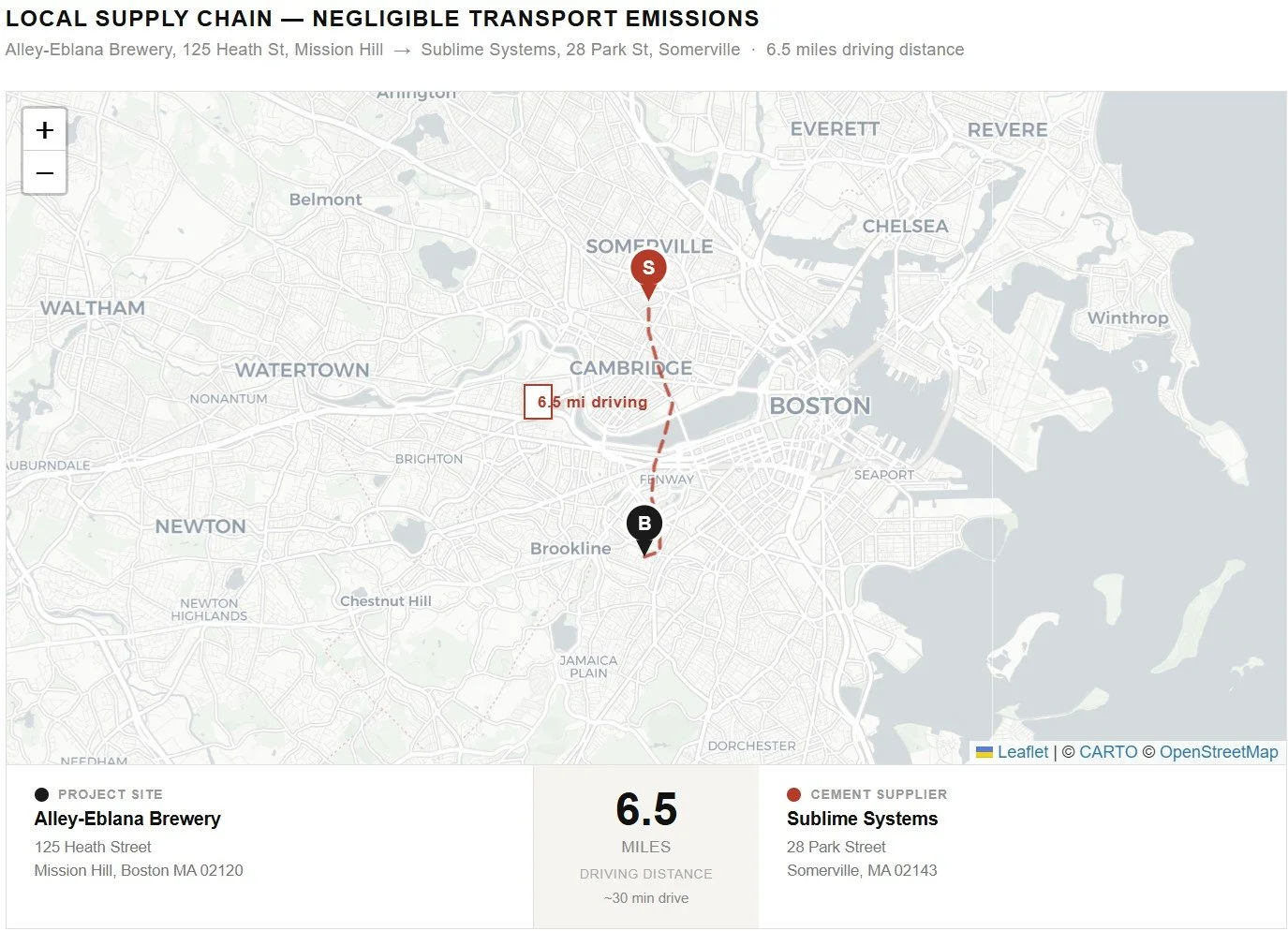
To push further, the analysis identifies Sublime Systems as a locally available net-zero cement manufacturer located just 6.5 miles from the site. Unlike ordinary Portland cement , which emits CO₂ through both fuel combustion and the chemical decomposition of limestone, Sublime Systems uses an electrochemical process that replaces limestone with non-carbonate rocks, avoiding both emission sources entirely. The process also enables the upcycling of construction waste and industrial by-products into new cementitious material, closing a second material loop alongside the GGBS substitution. At 6.5 miles from the site, transportation-related emissions are negligible.
Geometry & Structural Optimization
Beyond material selection, embodied carbon can be reduced by using less material altogether. Geometric and structural optimization, rationalizing spans, thinning slabs where loads allow, and eliminating redundant structure, cuts volume at the source before any carbon factor is applied. For the Alley-Eblana retrofit, this means designing floor plates to match structural spans efficiently, selecting prefabricated and modular slab systems that minimize waste in production, and specifying demountable partition systems that allow future reconfiguration without demolition. Each of these moves extends the useful life of material already in place, compounding the carbon benefit over the building's 100-year lifespan.
Sustainability Framework Alignment
The material strategies developed in this analysis align with several of the One Planet Living principles, providing a broader sustainability framing for the carbon work. The use of local, low-carbon cement (Sublime Systems) directly addresses Materials and Products and Zero Carbon Energy principles. The GGBS substitution, which repurposes an industrial byproduct, aligns with Zero Waste. The demountable partition system supports Materials and Products by enabling long-term adaptability. Taken together, these strategies are not isolated technical fixes but part of a coherent, principles-led approach to minimizing the carbon cost of making the building useful again.
Results
Both structural options, CLT and low-carbon concrete, meet the RIBA 2030 Challenge targets, landing well below the 2025 benchmark of 650 kgCO₂e/m² and below the more demanding 2030 target of 500 kgCO₂e/m². The concrete pathway, at 209 kgCO₂e/m² (185 kgCO₂e/m² with sequestration), is the more robust choice for a 100-year lifespan given the uncertainties embedded in CLT's biogenic carbon accounting. The key takeaway is that retaining the existing building fabric, which carries zero new embodied carbon, is itself the most powerful carbon reduction strategy; the analysis focuses on minimizing the impact of what must be added, not what is already there.